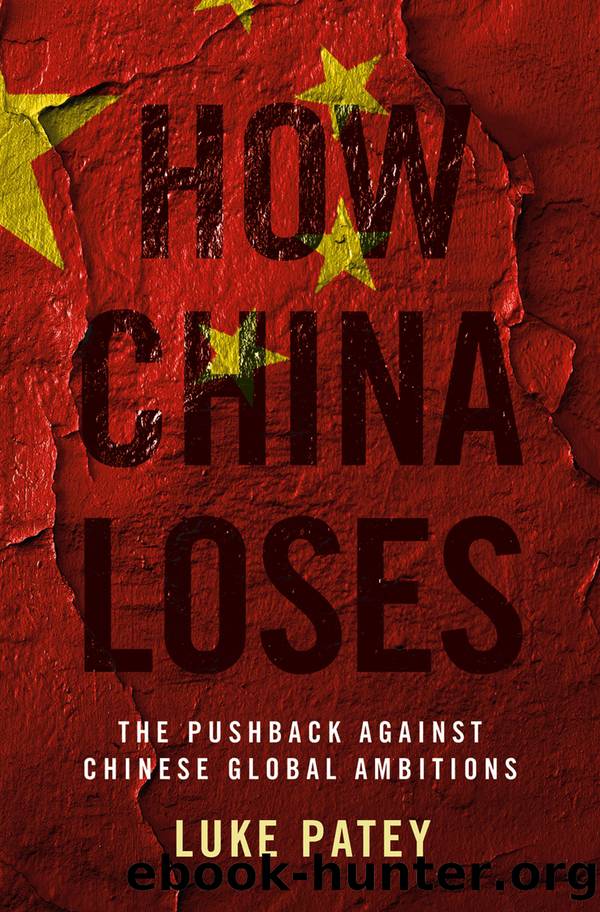
How China Loses by Luke Patey
Author:Luke Patey
Language: eng
Format: epub
Publisher: Oxford University Press
Published: 2020-03-15T00:00:00+00:00
Chapter 7
Behave Accordingly
If there are two visions of Japanâs future with China, Kiyoyuki Seguchiâs is the optimistic one. A research director at the Canon Institute for Global Studies, after a lengthy career at the Bank of Japan, which included holding the post of chief representative in China, Seguchi knows the ins and outs of Japanâs economic relations with its large neighbor. We met at his Tokyo office in the Shin Marunouchi Building, a commercial tower rising high above the cityâs elegant, red-brick central train station below. From his vantage point, even after a decade of tumultuous political and security relations, Seguchi still sees economic integration through trade and investment bringing regional peace and stability to East Asia. âEconomic relations between Japan and China cannot improve political relations in the short term,â Seguchi told me, âbut in the long run, there will be many good chances. It will work.â
Seguchi is not naïve to the challenges facing Japan and China. But his prediction of a future rapprochement differs sharply from the troubled road ahead that many in Japanâs political establishment and diplomatic service envision. Many Chinese would also disagree with his perspective. China maintains long-standing grievances dating back to Japanâs wartime aggression and occupation from the late 1930s till the end of World War II. This history is tied to present-day territorial disputes and military tensions over control of a small grouping of uninhabited islands in the East China Sea, known as Senkaku in Japan and Diaoyu in China. For the past decade, Beijing has increased pressure over its territorial claims, with the number of Chinese commercial, coast guard, and navy vessels and military aircraft traveling on and above the waters around the islands growing significantly. On nearly a daily basis, the Japanese air force must scramble to intercept Chinese military aircraft. Beijing even weaponized its trade with Japan, supporting consumer boycotts of Japanese products and export bans, to push Japan away from historical claims to the islands. China and Japan may be the second and third largest economies in the world, but even though a sense of normalcy has settled over their territorial disputes in recent years, an accidental collision at air or sea still threatens to spark war.
Will China and Japanâs economic relationship save Asia from a disastrous war? If not war, what impact might political and security tensions have on what is arguably the most important relationship in Asia? Pinned on the wall in Seguchiâs office are two green turtle figurines, one larger than the other. A revered animal in Japan and Asia, the turtle represents the connection between heaven and earth, symbolizing good luck and longevity. It is not hard to imagine those on Seguchiâs wall as Japan and China chasing one another over the centuries for economic supremacy in East Asia. In 2005, Chinaâs economy was only half the size of the Japanese. But after passing Japan to become the worldâs second largest economy in 2010, in nominal measures of gross domestic product, China was close to three times the size of the Japanese economy by 2018.
Download
This site does not store any files on its server. We only index and link to content provided by other sites. Please contact the content providers to delete copyright contents if any and email us, we'll remove relevant links or contents immediately.
| Anthropology | Archaeology |
| Philosophy | Politics & Government |
| Social Sciences | Sociology |
| Women's Studies |
Cecilia; Or, Memoirs of an Heiress — Volume 1 by Fanny Burney(32558)
The Great Music City by Andrea Baker(32018)
Cecilia; Or, Memoirs of an Heiress — Volume 2 by Fanny Burney(31956)
Cecilia; Or, Memoirs of an Heiress — Volume 3 by Fanny Burney(31941)
We're Going to Need More Wine by Gabrielle Union(19045)
All the Missing Girls by Megan Miranda(16023)
Pimp by Iceberg Slim(14506)
For the Love of Europe by Rick Steves(14121)
Bombshells: Glamour Girls of a Lifetime by Sullivan Steve(14073)
Talking to Strangers by Malcolm Gladwell(13370)
Norse Mythology by Gaiman Neil(13363)
Fifty Shades Freed by E L James(13239)
Mindhunter: Inside the FBI's Elite Serial Crime Unit by John E. Douglas & Mark Olshaker(9339)
Crazy Rich Asians by Kevin Kwan(9290)
The Lost Art of Listening by Michael P. Nichols(7506)
Enlightenment Now: The Case for Reason, Science, Humanism, and Progress by Steven Pinker(7311)
The Four Agreements by Don Miguel Ruiz(6763)
Bad Blood by John Carreyrou(6621)
Weapons of Math Destruction by Cathy O'Neil(6279)
